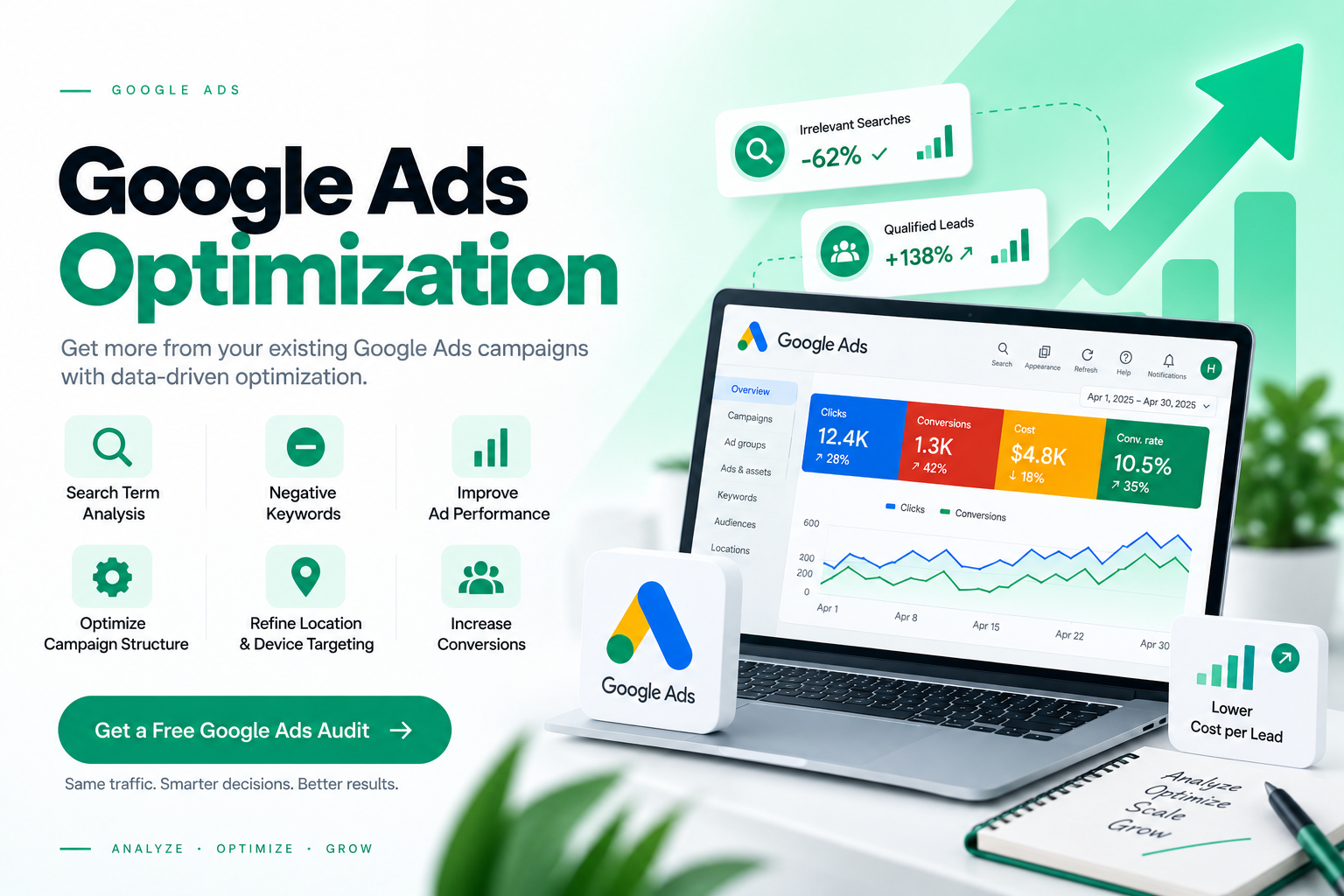
Review actual searches triggering your ads to find irrelevant traffic, useful new searches, and opportunities to improve targeting.
Negative Keywords
Review keyword performance, match types, search intent, and conversion data to improve the traffic entering your campaigns.
Search Term Analysis
Review keyword performance, match types, search intent, and conversion data to improve the traffic entering your campaigns.
Ad Optimization
Improve responsive search ads by reviewing headlines, descriptions, keyword relevance, and the search intent behind each campaign.
Campaign Structure
Separate services and search intent where needed so performance can be measured and optimized more effectively.
Optimization Based on Real Google Ads Data
I don't optimize an account by changing settings at random. I look at what people searched, what they clicked, what converted, what it cost, and where the account is losing efficiency.
Results Analysis
Compare clicks, conversions, conversion rate, CPC, and cost per conversion to understand which parts of the account are producing measurable results.
Underperformer Control
Identify keywords, ads, ad groups, and campaigns that consistently use budget without producing enough useful conversion activity.
Ads Budget Allocation
Use campaign performance data to identify where budget is producing stronger results and where spending needs closer control.
Location & Time Analysis
Review performance by location and time where sufficient data is available to identify opportunities for better targeting and budget allocation.
From Data Review to Continuous Optimization
Google Ads optimization is an ongoing process. Search behavior changes, new queries appear, and campaign performance moves over time, so the account needs regular review and adjustment.
01
Measure
Review campaign performance using the conversion and cost data available in the Google Ads account.
02
Identify
Find irrelevant searches, weak-performing areas, new search opportunities, and campaign issues that require attention.
03
Optimize
Apply focused changes to keywords, negative keywords, ads, campaign structure, targeting, and budget allocation.
03
Monitor
Track performance after changes and use the new data to decide what should be adjusted, maintained, or scaled.
I start by reviewing where the budget is actually going. Search terms are analyzed for irrelevant traffic, negative keywords are added where appropriate, and underperforming areas are reviewed against their conversion and cost data.
There is no useful one-size-fits-all schedule. Campaigns should be reviewed according to their traffic, conversion volume, spending, search activity, and how quickly meaningful performance data accumulates.
Yes. I can work from an existing account and review its campaign structure, keywords, search terms, ads, conversion tracking, targeting, spending, and historical performance before deciding what needs to change.
Conversions are the more important business signal when reliable conversion tracking is available. Clicks and CPC help explain traffic and cost, but optimization should ultimately consider whether that traffic produces the actions the business wants.